
Introduction
Every parent has experienced it.
One day, your toddler happily eats mashed carrots and peas. The next day, they act as if broccoli is poison and spinach belongs in the trash. Mealtime suddenly becomes a battlefield filled with negotiations, dramatic facial expressions, and vegetables flying across the room.

Parents often assume picky eating is simply stubborn behavior or bad habits. But science tells a very different story.

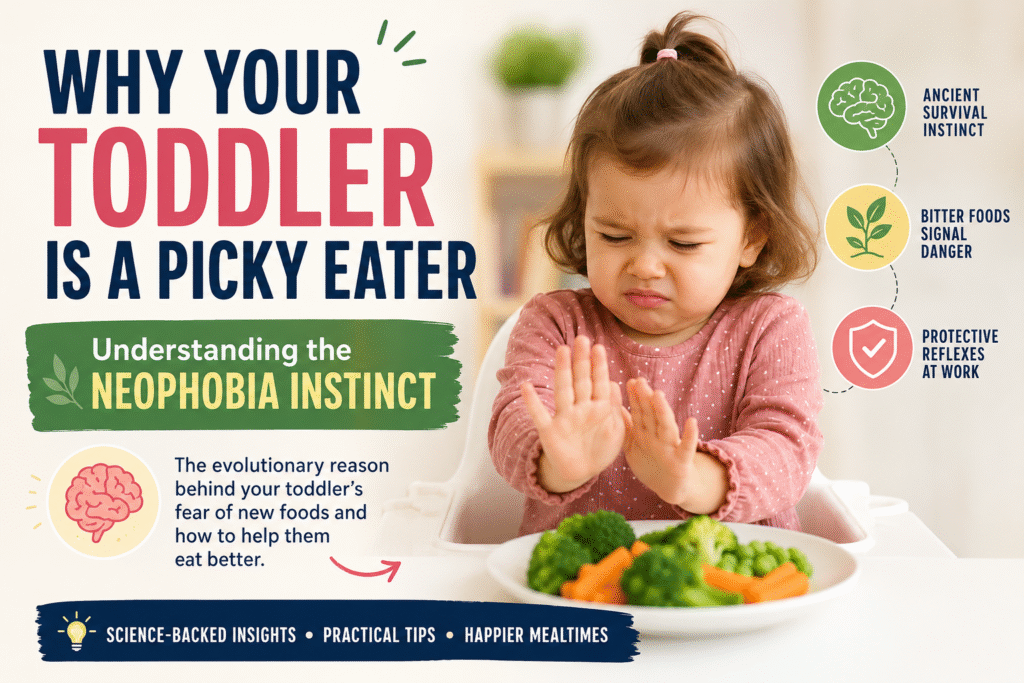
Your toddler’s refusal to eat unfamiliar foods may actually be rooted in evolutionary biology. Deep inside the developing brain lies an ancient survival mechanism called food neophobia—the natural fear of new or unfamiliar foods. Thousands of years ago, this instinct protected young children from eating poisonous plants and toxic substances in the wild.

In today’s modern kitchens, however, that same survival instinct creates frustration for parents trying to serve healthy vegetables and balanced meals.

Understanding the biology behind picky eating can completely change the way parents approach mealtime. Instead of seeing your toddler as “difficult,” you begin to recognize that their brain is trying to keep them safe.

What Is Food Neophobia in Toddlers?
Food neophobia refers to the fear or avoidance of unfamiliar foods. It is one of the most common developmental behaviors during toddlerhood and usually appears between the ages of 2 and 6 years.
This stage often surprises parents because babies usually accept a wide variety of foods during infancy. Suddenly, toddlers begin rejecting foods they previously enjoyed.

Why does this happen?
During early childhood, children become more mobile and independent. From an evolutionary perspective, this is the exact age when ancient human children would begin exploring their environment without constant parental supervision. Because poisonous berries, toxic plants, and spoiled foods could be deadly, the brain developed protective mechanisms to reduce risk.

The result?
Toddlers naturally become cautious eaters.
They may:
- Reject unfamiliar foods
- Avoid mixed textures
- Refuse bitter vegetables
- Smell foods before tasting
- Gag at certain textures
- Prefer familiar “safe” foods

This behavior is not necessarily bad parenting or behavioral defiance. In many cases, it is biologically normal.

The Evolutionary Origin of Picky Eating
To understand picky eating, we need to travel back thousands of years.
Early humans lived in environments where identifying safe food was essential for survival. Adults learned through experience which plants were nutritious and which were poisonous. Young children, however, lacked that knowledge.

Nature solved this problem through evolutionary adaptation.
Children developed stronger aversions to:
- Bitter tastes
- Unfamiliar smells
- Strange textures
- Unknown foods

Why bitter foods specifically?
Many naturally toxic plants contain bitter compounds. Over time, the human brain learned to associate bitterness with potential danger. This protective system dramatically reduced accidental poisoning in children.
Even today, toddlers instinctively reject foods with bitter flavor profiles, including:
- Broccoli
- Kale
- Spinach
- Brussels sprouts
- Cauliflower
Ironically, these are the exact foods parents desperately want their children to eat.

Why Green Vegetables Trigger Resistance
Green vegetables are among the most nutrient-dense foods available, but toddlers often treat them like enemies.
The reason lies in taste perception.
Vegetables contain phytochemicals and bitter compounds that activate specialized taste receptors on the tongue. Some children are genetically more sensitive to these compounds than others.

Researchers sometimes call these children “super tasters.”
For super tasters:
- Broccoli may taste extremely bitter
- Spinach may feel unpleasant
- Kale may trigger disgust instantly

Adults often underestimate how intense these flavors can feel to a toddler.
A vegetable that tastes mildly bitter to you may feel overwhelmingly unpleasant to your child.
This explains why forcing vegetables rarely works. If a food genuinely tastes offensive to a child’s sensory system, pressure can increase anxiety and reinforce food aversion.
The Protective Gag Reflex Explained

Many parents panic when toddlers gag during meals. However, gagging and choking are not the same thing.
The gag reflex is a protective mechanism designed to prevent unsafe swallowing.
Toddlers have:
- Smaller airways
- Developing chewing skills
- Heightened oral sensitivity
As a result, unusual textures can trigger gagging more easily.


Foods commonly associated with gagging include:
- Mushy vegetables
- Slimy textures
- Mixed foods
- Fibrous foods
- Chunky textures
Sensory sensitivity also plays a major role. Some children experience textures more intensely than others. A soft mushroom or steamed spinach leaf may feel extremely uncomfortable inside the mouth.
This does not mean your child is spoiled or dramatic.
Their nervous system is reacting protectively.
Modern Kitchens vs Ancient Survival Brains
Today, most foods served to toddlers are safe, washed, cooked, and carefully prepared.
But evolution moves slowly.
Your toddler’s brain still operates using ancient protective instincts developed in dangerous environments.
This creates a mismatch between biology and modern parenting expectations.

Parents expect:
- Balanced nutrition
- Variety
- Vegetable acceptance
- Calm mealtimes
But toddlers are biologically programmed to:
- Prefer familiarity
- Avoid bitterness
- Reject uncertainty
- Stay cautious around new foods
This understanding is important because it changes parenting strategies.
When parents pressure children to eat, the brain often interprets mealtime as stressful or unsafe. This increases anxiety around food and can strengthen picky eating behaviors over time.
Psychological Factors That Intensify Picky Eating
Biology is only part of the story.
Psychological and emotional factors can also intensify picky eating.
Toddlerhood is a stage of growing independence. Children want control over their bodies, choices, and environment. Food becomes one of the easiest ways to express autonomy.

Common triggers include:
- Pressure to finish meals
- Punishment during mealtime
- Bribing with desserts
- Emotional tension at the table
- Excessive focus on eating
When meals become stressful, children may associate unfamiliar foods with anxiety.

This creates a negative cycle:
- Child rejects food
- Parent becomes worried
- Pressure increases
- Child becomes more resistant
- Mealtime stress grows
Breaking this cycle requires patience and calm consistency.
Evidence-Based Strategies to Reduce Food Neophobia
The good news is that food neophobia can improve significantly over time.
Here are evidence-based strategies that actually help.
1. Repeated Exposure Works
Children may need 10–15 exposures before accepting a new food.
Exposure does not mean forcing them to eat it.
Simply:
- Place the food on the plate
- Let them touch it
- Allow smelling or licking
- Normalize its presence
Familiarity reduces fear.

2. Use the “Tiny Taste” Method

Large portions can overwhelm toddlers.
Instead:
- Offer tiny bites
- Celebrate small progress
- Avoid pressure
Even a single lick is progress.
3. Model Healthy Eating
Children learn by observation.

When parents regularly eat vegetables with enjoyment, children are more likely to imitate the behavior over time.
Family meals are powerful teaching environments.
4. Avoid Force Feeding
Forcing food can worsen neophobia and create long-term food anxiety.
Instead:
- Stay calm
- Respect fullness cues
- Keep mealtimes positive
The goal is building trust, not winning battles.
5. Involve Toddlers in Food Preparation
Children are more likely to try foods they helped prepare.
Simple activities include:
- Washing vegetables
- Stirring ingredients
- Choosing produce at the store
- Arranging food on plates
Food exploration reduces fear.
Nutritional Risks of Extreme Picky Eating

Most picky eating phases are temporary and normal.
However, extreme restriction may increase the risk of nutrient deficiencies.
Common concerns include:
- Iron deficiency
- Zinc deficiency
- Low vitamin D
- Inadequate fiber intake
- Poor protein diversity

Signs parents should watch for:
- Fatigue
- Poor growth
- Constipation
- Frequent illness
- Weight concerns
If a toddler eats fewer than 10 foods consistently or experiences severe distress around eating, professional evaluation may help.
Helpful organizations include:
- American Academy of Pediatrics
- World Health Organization
When Picky Eating May Signal Something More Serious
Sometimes feeding difficulties extend beyond normal developmental neophobia.
Parents should seek medical advice if children:
- Lose weight
- Avoid entire food groups
- Experience choking fears
- Show severe sensory distress
- Refuse nearly all textures
Conditions that may contribute include:
- ARFID (Avoidant Restrictive Food Intake Disorder)
- Autism-related sensory sensitivities
- Oral motor difficulties
- Gastrointestinal problems
Early intervention can greatly improve outcomes.

Conclusion
Toddler picky eating is not simply stubbornness.
In many cases, it is the result of millions of years of evolutionary survival programming designed to protect young children from danger. The same instinct that once helped ancient humans avoid poisonous plants now causes modern toddlers to reject broccoli and spinach at the dinner table.
Understanding food neophobia helps parents approach mealtime with more patience and less frustration.
Your toddler is not trying to make life difficult.
Their ancient survival brain is simply doing its job.
With repeated exposure, calm mealtimes, positive role modeling, and patience, most children gradually expand their food preferences and develop healthier relationships with food.

Frequently Asked Questions (FAQs)
Why do toddlers suddenly become picky eaters?
Toddlers often become picky eaters between ages 2 and 6 because of food neophobia, a natural fear of unfamiliar foods linked to evolutionary survival instincts.
Why do toddlers hate vegetables?
Many vegetables contain bitter compounds that ancient human brains associated with toxicity. Toddlers are naturally more sensitive to these bitter tastes.
Is picky eating genetic?
Yes. Some children inherit stronger taste sensitivity, making certain foods taste more bitter or intense compared to others.
Should parents force toddlers to eat?
No. Force feeding can increase anxiety around food and worsen picky eating behaviors. Gentle repeated exposure works better.
How long does food neophobia last?
Food neophobia commonly peaks during toddlerhood and gradually improves as children grow older and become more familiar with different foods.
When should I worry about picky eating?
Parents should seek professional advice if picky eating causes weight loss, poor growth, severe nutritional deficiencies, or extreme food restriction.
Also read:
[smartslider3 slider=”21″]