
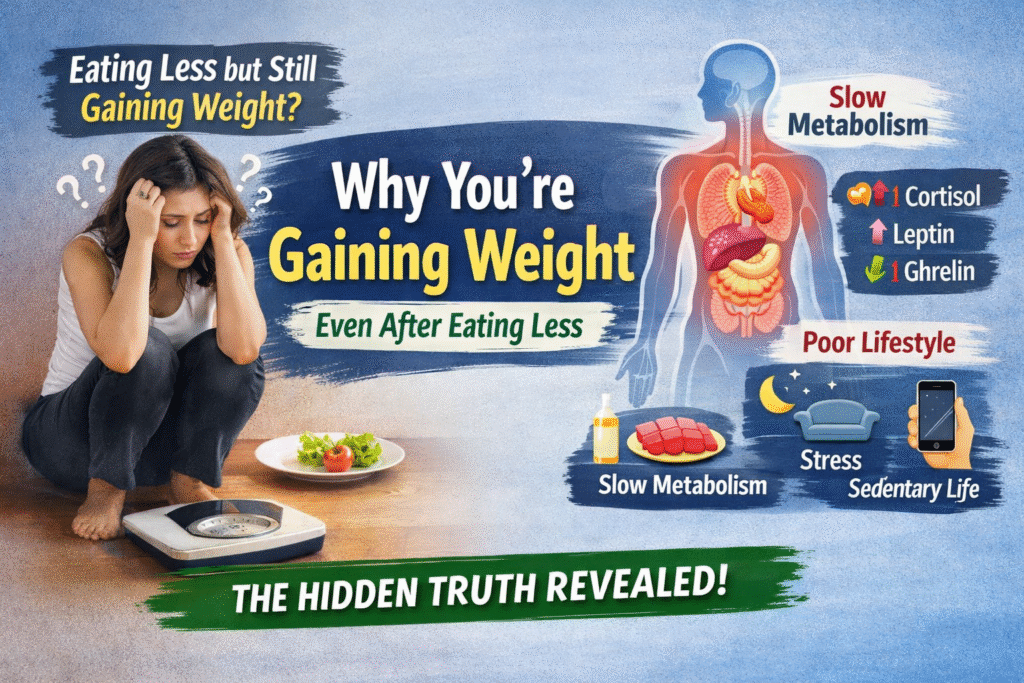
The Frustrating Reality
You’ve cut down your food.
You’re skipping meals.
You’re trying your best to eat “less.”
And yet… the scale is not moving—or worse, it’s going up.
Sounds unfair, right?
But here’s the truth:
Eating less doesn’t always mean losing weight.
In fact, in many cases, it can do the opposite.
Problem: The “Eat Less = Lose Weight” Myth
Most people believe weight loss is simple: “Just eat less and move more.”
While this sounds logical, but your body is not a calculator—it’s a survival machine.

When you drastically reduce food intake:
- Your body thinks you’re starving
- It slows down metabolism
- It starts conserving fat instead of burning it
This leads to:
- Weight loss plateaus
- Fat gain despite low food intake
- Constant fatigue and cravings
So the real problem isn’t eating less…
It’s eating less in the wrong way.
Science: What’s Really Happening Inside Your Body
Let’s break down the hidden biological mechanisms:
1️⃣ Metabolic Adaptation (Starvation Mode)
When you eat too little, your body reduces calorie burning to survive.
👉 This is called adaptive thermogenesis.
Result: You burn fewer calories—even at rest.
2️⃣ Hormonal Imbalance
- Leptin (satiety hormone) decreases → you feel hungry
- Ghrelin (hunger hormone) increases → cravings rise
- Cortisol (stress hormone) increases → fat storage increases
Especially belly fat!
3️⃣ Muscle Loss Instead of Fat Loss
If protein intake is low:
- Your body breaks down muscle
- Muscle loss slows metabolism further
Less muscle = fewer calories burned daily
4️⃣ Poor Food Quality
Eating less but consuming:
- Processed foods
- Sugary snacks
- Refined carbs
Leads to fat gain despite low calories
5️⃣ Hidden Lifestyle Factors
Weight gain isn’t just about food. It’s also influenced by:
- Poor sleep
- Excess screen time
- Chronic stress
- Sedentary lifestyle
Solution: What You Should Do Instead
Stop focusing on “eating less”
Start focusing on “eating right.”
Here’s the smarter approach:
1. Eat Enough Protein
- Supports fat loss
- Preserves muscle
- Keeps you full longer
👉 Include: dal, paneer, eggs, lean meat

2. Follow a Balanced Diet
Your plate should have:
- Protein
- Healthy fats
- Complex carbs
- Fiber
Think: “balanced thali,” not starvation

3. Improve Meal Timing
- Avoid long gaps → prevents overeating later
- Try structured eating (not random snacking)
4. Strength Training is Essential
Not just cardio!
👉 Muscle building = higher metabolism
5. Fix Your Lifestyle
- Sleep: 7–8 hours
- Manage stress
- Reduce screen time
Action Tip: Start Today (Simple Plan)
If you’re confused, follow this easy 3-step reset:
👉 Step 1: Add protein to every meal
👉 Step 2: Stop skipping meals
👉 Step 3: Walk 30 minutes daily
That’s it. Start simple.
Final Takeaway
Weight loss is not about starving yourself.
It’s about fueling your body intelligently.
If you eat too little, your body fights back.
If you eat right, your body works with you.
Want to understand weight loss deeply?
Watch our detailed video on this topic on Women’s Wellness Diary
For more such science-backed health tips, visit: www.healthlivehub.in
Also Read: Soft & Nutritious Millet Idli Recipe (Ragi + Suji) – A Healthy South Indian Twist