
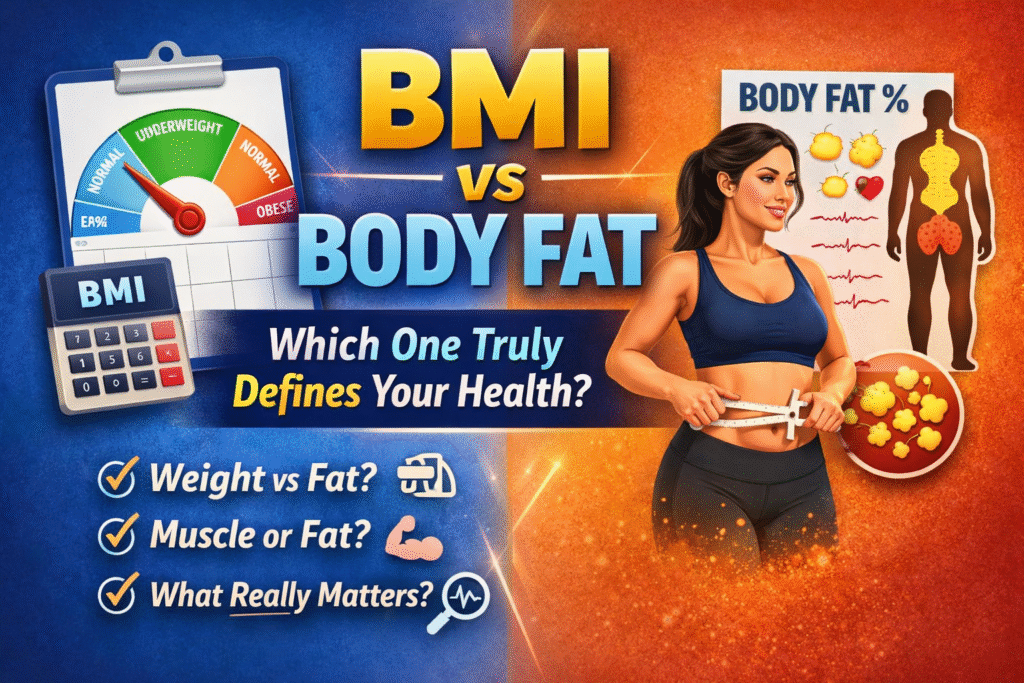
Introduction: The Big Fitness Myth
When it comes to measuring health, most people rely on a single number — BMI (Body Mass Index). But is BMI really enough to tell whether you’re healthy?
What if you have a “normal” BMI but still carry excess fat? Or a “high” BMI but are actually fit and muscular?
This is where body fat percentage becomes a game-changer.
Let’s break down the truth behind BMI vs body fat — and which one really matters for your health.
What is BMI?
BMI (Body Mass Index) is a simple calculation using your height and weight:
Formula:
BMI = Weight (kg) / Height (m²)
BMI Categories
- Underweight: <18.5
- Normal: 18.5 – 24.9
- Overweight: 25 – 29.9
- Obese: ≥30
Pros of BMI
✔ Easy to calculate
✔ Quick screening tool
✔ Widely used in healthcare
Limitations of BMI
❌Doesn’t differentiate between fat and muscle
❌ Cannot show fat distribution
❌ May misclassify athletes and muscular individuals
Example: A gym trainer with high muscle mass may be labeled “overweight” by BMI.
What is Body Fat Percentage?
Body fat percentage tells you how much of your body is made up of fat.
Healthy Body Fat Ranges
For Men:
- Essential fat: 2–5%
- Healthy: 10–20%
- Obese: >25%
For Women:
- Essential fat: 10–13%
- Healthy: 18–28%
- Obese: >32%
Ways to Measure Body Fat
- Skinfold calipers
- Bioelectrical impedance (smart scales)
- DEXA scan (most accurate)
BMI vs Body Fat: Key Differences
Women’s Wellness Diary@healthlivehub
| Feature | BMI | Body Fat % |
|---|---|---|
| Measures | Weight vs height | Actual fat content |
| Accuracy | Low for individuals | High |
| Muscle consideration | No | Yes |
| Health risk prediction | Limited | Better |
| Ease of use | Very easy | Requires tools |
Why Body Fat Matters More
1. Reveals Hidden Fat (Skinny Fat Problem)
You can have a normal BMI but still carry excess fat — especially around the abdomen.
2. Predicts Health Risks Better
High body fat is strongly linked to:
- Diabetes
- Heart disease
- Hormonal imbalance
3. Focuses on Fat Loss, Not Just Weight Loss
Losing weight doesn’t always mean losing fat. You could be losing muscle instead.
When BMI is Still Useful
BMI is not useless — it’s helpful for:
- Large population studies
- Initial health screening
- Quick risk assessment
But it should never be the only measure.
What Should You Track Instead?
For better health insights, combine:
✔ Body fat percentage
✔ Waist circumference
✔ Muscle mass
✔ Physical fitness levels
A holistic approach gives the most accurate picture of your health.
Expert Tip: The Ideal Approach
Instead of obsessing over weight:
- Focus on fat loss + muscle gain
- Maintain a balanced diet
- Include strength training
- Stay active daily
Conclusion: The Real Winner
BMI is a starting point — not the final answer.
Body fat percentage is a more accurate indicator of health.
If you truly want to understand your body and improve your fitness, shift your focus from weight to composition.
Also Read: Obesity is not just that simple-its Hormonal and Neurometabolic crisis!!