

Introduction
When we talk about health, most people think of weight, body mass index (BMI), or waist size. But did you know your neck size can also reveal important clues about your wellbeing?
Recent research shows that neck circumference (NC) is more than just a clothing measurement. It is increasingly recognized as an early health marker for conditions such as obesity, sleep apnea, diabetes, and cardiovascular disease (Preis et al., 2010). Measuring your neck is simple, quick, and requires only a tape measure.

In this blog, we’ll explore:
- What neck circumference is
- Why it matters for health
- Its link to obesity, sleep apnea, and cardiovascular problems
- How to measure it correctly
- What the cut-off values mean for men and women
- Lifestyle changes that can reduce related health risks

What is Neck Circumference?
Neck circumference (NC) is the measurement taken around the middle of your neck.
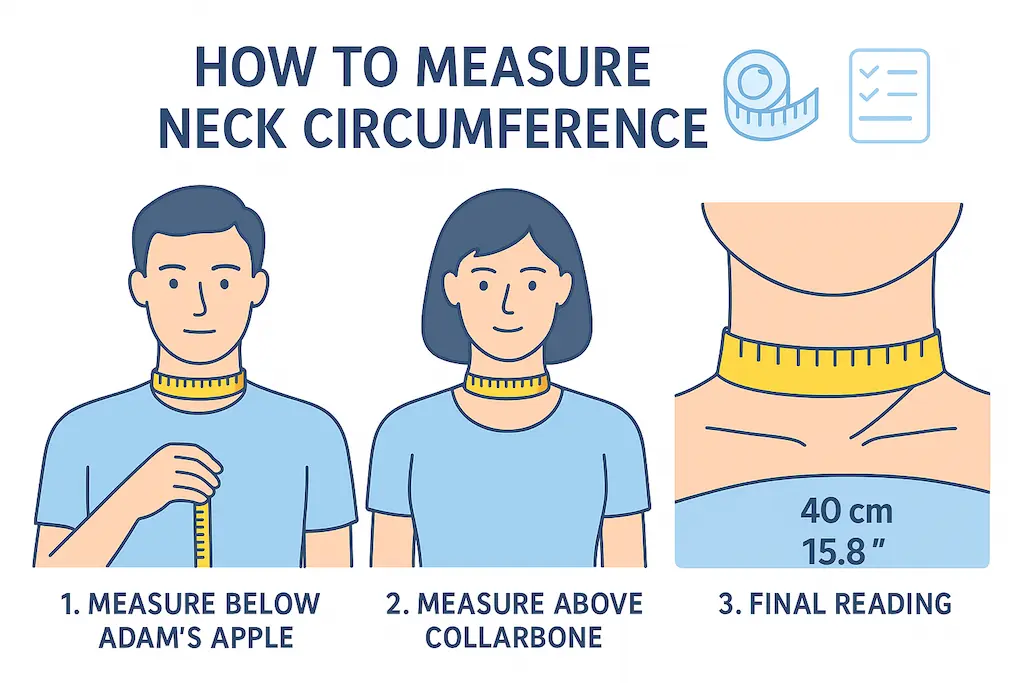
- For men, it is usually measured just below the Adam’s apple.
- For women, it is measured just above the collarbone.
It might seem like a small detail, but this simple measurement provides insight into fat distribution in the upper body, particularly around the airway and chest (Ben-Noun & Laor, 2003).
Unlike BMI, which considers overall weight, NC reflects upper-body subcutaneous fat, which has unique health implications.
Why Neck Size Matters for Health
You may wonder: Why measure the neck when BMI and waist circumference already exist?
Here’s why NC is gaining popularity in health studies:
- Simple and Practical: No special equipment or calculations are needed.
- Stable Measurement: Waist circumference can change after meals, but neck size remains fairly stable (Onat et al., 2009).
- Indicator of Fat Distribution: Neck size reflects upper-body fat, which is metabolically more active and risky compared to fat stored in hips or thighs.
- Predictor of Health Risks: Larger NC has been linked with metabolic syndrome, cardiovascular risk, and sleep disorders (Preis et al., 2010).
This makes NC a useful, though not standalone, complementary tool for health screening

The Link Between Neck Circumference and Body Fat
Several studies have found a strong correlation between NC and obesity. For instance, Onat et al. (2009) showed that NC is positively associated with BMI, waist circumference, and body fat percentage.
Interestingly, even when BMI is similar, a person with a larger neck size may have more central obesity, which is more dangerous than fat stored elsewhere.
Cut-Off Values for Obesity
Population-based studies suggest that:
- Men with NC > 39–40 cm (15.5–16 inches) are at risk of obesity-related complications.
- Women with NC > 34–35 cm (13.5–14 inches) may also be at higher risk (Ben-Noun & Laor, 2003).
This highlights that NC is not just a cosmetic factor but a predictive health marker.
Neck Size and Sleep Apnea
Understanding Sleep Apnea
Obstructive Sleep Apnea (OSA) is a sleep disorder where breathing repeatedly stops and starts due to airway blockage. Symptoms include:
- Loud snoring
- Daytime fatigue
- Morning headaches
- Interrupted sleep cycles
How Neck Size Plays a Role
Excess fat around the neck reduces airway diameter and increases airway collapsibility during sleep, making OSA more likely (Davies & Stradling, 1990).
Risk Cut-Offs for Sleep Apnea
NC is often used in clinical practice to screen for OSA risk:
- Men with NC > 43 cm (17 inches) are considered high risk.
- Women with NC > 41 cm (16 inches) are at higher risk (Katz et al., 1990).
Thus, a thicker neck is not only an aesthetic issue—it can be a medical warning sign.
Neck Size and Cardiovascular Health
Beyond obesity and OSA, NC is increasingly linked to cardiometabolic health.
Research Highlights:
- Preis et al. (2010), in the Framingham Heart Study, found that larger NC was independently associated with higher blood pressure, insulin resistance, and dyslipidemia.
- Ben-Noun & Laor (2003) reported that NC was positively correlated with systolic blood pressure and serum cholesterol levels.
- Neck fat is metabolically active and releases more free fatty acids, contributing to arterial damage and heart strain (Onat et al., 2009).
This makes NC a non-invasive marker for early cardiovascular risk screening.

How to Measure Your Neck Size Correctly
Measuring NC is simple and reliable if done correctly.
Step-by-Step Guide:
- Use a flexible tape measure.
- Stand upright with your head looking forward.
- Place the tape:
- Just below the Adam’s apple for men.
- Just above the collarbone for women.
- Keep the tape snug but not tight.
- Record the result in centimeters or inches.
Best Practices
- Measure in the morning for consistency.
- Relax your shoulders and neck muscles.
- Take two readings and use the average.
When to Be Concerned About Your Neck Size
You should be cautious if:
- Your NC is above the cut-off values for your gender.
- You notice a sudden increase in neck size without lifestyle changes.
- You have symptoms like snoring, fatigue, or hypertension.
Ways to Reduce Health Risks Linked to Neck Size
Remember: NC is not a standalone diagnostic tool. It should be considered along with BMI, waist circumference, blood tests, and clinical evaluation.
If your NC is above normal, lifestyle changes can significantly reduce health risks.

1. Weight Management
- Focus on a balanced diet rich in vegetables, fruits, whole grains, and lean protein.
- Reduce intake of refined sugar, fried foods, and processed snacks (WHO, 2020).
2. Regular Exercise
- Aerobic activity (walking, running, cycling) helps burn overall fat.
- Strength training increases metabolism and supports long-term weight loss.
3. Improve Sleep Hygiene
- Maintain a fixed sleep schedule.
- Avoid alcohol before bed, as it worsens OSA.
- Seek medical help if you have persistent snoring or excessive daytime sleepiness.
4. Regular Health Check-Ups
- Monitor blood pressure, cholesterol, and glucose levels.
- If OSA is suspected, ask for a polysomnography (sleep study).

Easily Access Medical Care Abroad. Air Doctor connects travelers to private doctors worldwide. From Germany to New York, we can help you find a doctor
Neck Size vs. Other Health Markers
| Marker | What it Measures | Pros | Cons |
| BMI | Weight relative to height | Easy to calculate, widely used | Doesn’t show fat distribution |
| Waist Circumference | Abdominal fat | Good metabolic risk predictor | Changes after meals |
| Waist-Hip Ratio | Balance of fat distribution | Useful for central obesity | Slightly complex to measure |
| Neck Circumference | Upper-body fat & airway risk | Easy, stable, predictive | Still under research |
👉 The best approach is to use a combination of these markers for a complete picture.

Frequently Asked Questions (FAQ)
1. Is neck size alone enough to detect obesity?
No. NC is a useful screening tool, but it should be combined with BMI, waist size, and medical tests for accuracy (Onat et al., 2009).
2. Can losing weight reduce neck size?
Yes. Weight loss usually reduces NC, which can also improve breathing and reduce sleep apnea risk (Katz et al., 1990).
3. Are genetics involved in neck circumference?
Yes, genetics influence where fat is stored. Some people naturally accumulate more fat in the upper body (Preis et al., 2010).
4. Should I worry if my neck is large but I’m otherwise healthy?
Not necessarily. If your blood pressure, cholesterol, and glucose levels are normal, a large neck may not be harmful. But it’s wise to monitor it.
5. How often should I measure my neck circumference?
Once every few months is sufficient, unless you are tracking weight loss or under medical supervision.
Conclusion
Your neck size is more than just a clothing measurement—it can be a valuable health signal. Studies show that larger NC is linked with obesity, obstructive sleep apnea, hypertension, and cardiovascular disease (Ben-Noun & Laor, 2003; Preis et al., 2010).
The good news is that NC is easy to measure and can serve as a practical screening tool in combination with BMI and waist circumference.
So, grab a tape measure today. By tracking your neck size, you might gain an early warning signal about your health—and an opportunity to make changes before serious conditions develop.